To stop dog pee from killing your grass, pour water on the spot right after your dog goes, and teach your dog to use one potty spot instead of the whole lawn. VCA Animal Hospitals calls watering right away the most reliable way to prevent the burn. Colorado State University Extension calls a set potty area the only sure solution.
You love your dog. You also liked your lawn before the yellow polka dots showed up. The fix is a watering can and a little training.
This is where a real grass pad earns its keep. As our FAQ puts it, dogs like to do their business on real grass. Set a DoggieLawn in a corner of the patio or along the side of the house, and your dog gets a grassy spot of their own. Your lawn gets to stay a lawn.
What you'll need to protect your lawn
Here's how to stop dog pee from killing grass with things you mostly own already. Nothing on this list goes in your dog's food bowl.
- A watering can or hoseKept by the back door, so rinsing takes seconds
- One potty spotA corner you don't mind, or a patch of mulch or gravel
- A DoggieLawn real grass padHydroponically grown real grass to set in that spot
- Small treatsHidden in your pocket for training sessions
- Seed or sod that matches your lawnFor the patches that are already dead
Why dog pee kills grass
Dog pee kills grass because it drops too much nitrogen and salt on one small patch. Colorado State University Extension, in its fact sheet on dog urine damage on lawns, says the damage occurs when a high concentration of nitrogen-containing compounds and associated salts lands in a small area.
Think of fertilizer. VCA Animal Hospitals explains that nitrogen feeds plants in small amounts, and that too much in one place burns the grass. If you're seeing dog pee killing grass in neat circles, that's the classic pattern. A 2006 turf guide from Purdue University and the University of Illinois describes a dead brown center 3 to 6 inches across with a dark green ring around it. The ring got a snack. The middle got the whole buffet.
Acid is not behind dog urine killing grass. VCA calls that a common misconception. The Purdue guide adds an honest footnote: the exact mechanism of urine injury is not completely understood.
Three things make dog urine on grass more likely to leave a mark:
- Squatting: VCA says any dog that prefers to squat in one area is more likely to burn the grass.
- Size: larger dogs produce more urine, so their spots are more obvious, Colorado State says.
- Dry, hot weather: the Purdue guide says turf can die in 24 hours or less in hot, dry conditions.
So dog pee burning grass is a dose problem. That points to two fixes: dilute the dose, or move it.
Water the spot right after your dog pees
Pour water on the spot as soon as your dog finishes. If you've searched how to neutralize dog urine on grass, water is the whole answer. Colorado State says water is the only thing that can neutralize the urine's negative effects. VCA says the most reliable way to prevent the burn is to water the grass immediately after your dog urinates.
A watering can works, and so does a hose. None of the sources we read gives a number of gallons or minutes. What VCA is clear on is timing: immediately.
Keep a full watering can by the door your dog uses. If rinsing means untangling a hose at 6 a.m., it won't happen.
One honest limit: you can't follow your dog around the yard all day. That's why Step 2 matters more.
Give your dog one potty spot
Pick one place for pee and teach your dog to use it. Colorado State's advice is to train the dog to use a non-turf area, such as mulch or gravel, or a location where the damage can be tolerated. It calls this the only sure solution.
Good spots are out of sight and easy to reach, like a back corner or the side of the house. Our post on outdoor and indoor potty training says a set time and location make it easier for your dog to understand what you expect. One set spot is the habit behind a backyard without dog pee burning grass.
Then comes the teaching. Our DoggieLawn training guide introduces a new potty place in three steps. The guide is written for a DoggieLawn, so set your pad in the spot first (Step 3 covers setup). Here are its steps.
- Start when your dog has a full bladder, such as first thing in the morning.
- Keep a treat in your pocket, ready to reward your dog. Make sure they don't know it's there, since that's distracting.
- Place your dog on the DoggieLawn and say "go potty." If your dog sits, circles or does anything but pee or poo, place them back in the same spot on the DoggieLawn and say "go potty" again. Do this 20 to 30 times.
Twenty to thirty repeats can feel like a lot before coffee. Stay calm, and save the party for the moment your dog goes. Watch the training video on that page first. If you still need help after it, the same page lets you schedule a free personal training call with us.
Put a real grass pad in the potty spot
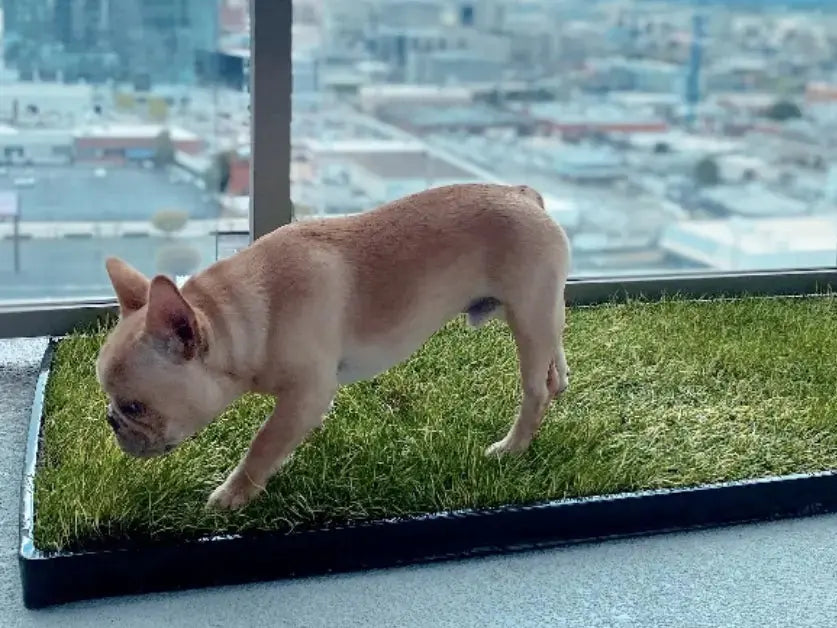
Set a real grass pad in the potty spot, so your dog has grass to pee on that isn't your lawn. A DoggieLawn real grass pad is real, hydroponically grown grass from California, delivered to your door. It takes the pee so your yard doesn't have to.
A yard is one of the places it's meant for. Our FAQ lists, among the people DoggieLawn is for, "homeowners that want to have a dog run on the side of the house in order to protect their grassy backyard."
A few setup notes from the same FAQ:
- Tray: indoors or on a balcony, a tray protects the floor. If you use the grass outside as a dog run, the tray may not be necessary.
- Rain: cover the grass while it rains or move it inside. Pups prefer their grass squish-free.
- When to swap: you'll know it's time to change the grass when your dog starts peeing on the edge of the lawn.
Choose the size that fits your dog and your space, and swap sizes anytime. The plan page is where you choose the right size grass pad and see what ships with your size. When in doubt, size up. Got a leg lifter? A Potty Training Fire Hydrant in the middle of the grass gives him a place to aim.
One fair note from our FAQ: most dogs take right to the grass, and we can't guarantee that every dog will. That's what the training in Step 2 is for.
Dog urine lawn repair for brown spots
Start with water, then replace only what is truly dead. If you're wondering how to fix dog urine spots on lawn grass that already looks scorched, Colorado State's first move is more irrigation. Brown turf may or may not be dead, and extra water dilutes the salts and may help grass that is still alive recover.
Give it time before you dig. The Purdue guide says the brown and green patches may persist for several weeks, depending on how vigorous the surrounding turf is and how well it can fill in. For dog pee spots on lawn areas that stay bare, Colorado State's repair is simple: remove the dead sod and 0.5 to 1 inch of soil, then lay new sod or reseed.
Match the seed to the lawn you have. Colorado State's pairings:
- Kentucky bluegrass lawn: perennial ryegrass seed works better than bluegrass seed for spots.
- Tall fescue lawn: turf-type tall fescue.
- Fine fescue lawn: fine fescue seed.
- Zoysia or bermudagrass lawn: patch with sod instead of seed.
The Purdue guide also suggests mowing high, 2 to 3 inches for most lawn grasses, so the turf recovers more easily. And fix the cause first. New dog urine spots on lawn you just reseeded are no fun, so get Steps 1 to 3 going before you buy seed.
Skip the urine-changing remedies
Ask your veterinarian before you add anything to your dog's bowl for the lawn's sake. Then skip the pills, powders and kitchen cures that promise to change your dog's pee. Colorado State says no dietary supplement has been scientifically proven to reduce dog spotting in lawns.
Some of them carry real risk. In its article Urine Scalding on Grass, written by veterinarian Courtney Barnes, DVM, VCA says that attempting to alter the pH of your dog's urine can negatively affect their health, for example by leading to crystals and stones in the urine. The Purdue turf guide, co-written by a Purdue veterinarian, calls dietary products for lawn spots potentially dangerous.
- Supplements that acidify urine: Colorado State says these may cause urinary system problems.
- Salt, garlic or tomato juice in food: Colorado State says to always ask your veterinarian first, and warns that extra salt can cause problems for older dogs and dogs with heart or kidney conditions.
- A low-protein diet: VCA does not recommend restricting protein, because it can be detrimental to a dog's health.
- Baking soda or gypsum on the grass: both are salts and may compound the problem, Colorado State says.
- Spray-on lawn cures: none has been scientifically proven to work, per Colorado State.
The one bowl change those sources back without a vet visit is more water. VCA suggests more than one water source, or water added to dry food, since a dog that drinks more has more dilute urine.
The simplest remedy changes where your dog pees and leaves the pee itself alone. Set a DoggieLawn in the potty spot, keep the watering can by the door, and let your lawn grow back. A subscription keeps fresh grass coming, and you can skip, pause, or cancel it anytime right from your account.
Frequently asked questions
Why Does Dog Pee Kill Grass?
Dog pee kills grass because it puts a concentrated dose of nitrogen and salts on one small patch. VCA Animal Hospitals compares it to too much fertilizer in one area: the grass burns. Watering the spot right after your dog goes is the most reliable way to prevent the burn, VCA says.
Does Female Dog Urine Kill Grass Faster?
No. VCA says female dogs get the blame because they are more likely to squat and urinate in one place, and that the sex of the dog is not the reason. Colorado State University Extension notes that some males squat too, especially in their own yard.
What Is the Best Grass for Dog Urine?
There is no fully dog urine resistant grass. Purdue Extension's turf guide says animal urine can damage any turfgrass species in any climate. Some hold up better: VCA notes that some varieties are less susceptible because they grow faster and root deeper. The best grass for dog urine is grass your dog is allowed to use up, like a real grass pad in a potty spot.