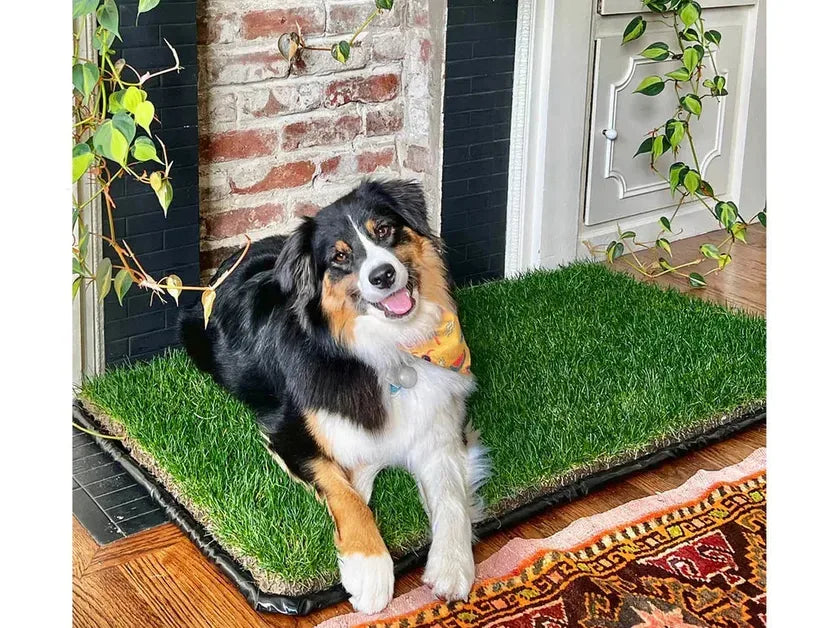
You can potty train an older dog, and it's often easier than training a puppy. The American Kennel Club (AKC) says housetraining is "often a much easier process" for adult dogs, because a grown dog can hold it for several hours. A real grass pad gives your dog a spot they recognize by smell and texture.
The hard part is the history. A dog who spent years somewhere else arrives with habits you didn't choose, and a rescue can't tell you what the old rules were. So this guide starts with a health check, then follows DoggieLawn's training guide: a full bladder, a hidden treat and a patient "go potty" on real grass.
Why real grass? Dogs already know what it's for. Our grass is real and hydroponically grown in California, and as our How It Works page puts it, dogs instantly recognize its smell and texture.
What you'll need to potty train an older dog
Wondering how to potty train an older dog without buying half the pet aisle? You need five things, and the last one is free. The list is the same if you're working out how to potty train an adult dog who just moved from a house with a yard to an apartment.
- A real grass padChoose the size that fits your dog and your space
- A tray under the grassProtects the floor indoors or on a balcony
- Small, tasty treatsKept in a pocket, out of sight
- Potty Training Boost sprayAn optional scent cue for the grass
- A few quiet morningsPatience counts as equipment here
Set the grass up before the first session, somewhere your dog can get to easily. Our How It Works page says you can place it on your balcony, patio, indoors or anywhere you can fit it.
For size, choose the one that fits your dog and your space, and swap sizes anytime. When in doubt, size up. The plan page shows what ships with your size.
Rule out a health problem first
Before any training, ask your veterinarian to rule out a medical cause, above all if the accidents started suddenly. VCA Animal Hospitals, in a guide written by three board-certified veterinary behaviorists, puts it plainly: "House soiling may be a sign of a physical illness."
VCA lists a wide set of illnesses that can affect house training. For seniors, VCA says physical changes in the brain that come with aging can affect a dog's memory and cause them to forget some of what they learned, house training included. Our post on potty changes in older dogs covers what owners tend to notice.
Going by VCA's list, tell your vet if you've seen any of these:
- The accidents started suddenly.
- A dog who was house trained for years has begun to slip.
- Your dog is drinking and peeing more than usual.
- Peeing or pooping looks painful or hard to finish.
No diagnosis happens on a blog, ours included. If your vet finds your dog physically and behaviorally healthy, VCA's advice is to restart training "as though your dog were a young puppy."
A rescue may only need a reminder. The Humane Society for Southwest Washington's adult dog housetraining guide says many adult shelter dogs were house trained in the past and need only a refresher lesson or two, while others start from square one.
Start when your dog's bladder is full
Run your first session when your dog really needs to go. DoggieLawn's training guide says to start "when your dog has a full bladder (such as first thing in the morning)."
For potty training adult dog sessions, this is the rule the guide puts first. VCA explains why: dogs learn a new potty spot quickly because they feel immediate relief when they go. In VCA's words, "The feeling of emptying a full bladder feels good and serves as a reward." Your dog pays themselves for getting it right.
So if you're working out how to house train an older dog, plan the session for when the odds are best. VCA notes a healthy adult dog can usually hold urine for about 3 to 4 hours if they are not active. First thing in the morning is the easiest full bladder to plan around, which puts the session before the morning walk, not after it.
Keep a treat ready but out of sight
Put a treat in your pocket before you call your dog over, and keep it hidden. The training guide is specific here: have a treat in your pocket ready to reward your dog, and make sure they don't know it's there, since that would be distracting.
A dog who has spotted the treat tends to think about the treat. Nobody pees while negotiating for a biscuit.
Place your dog on the grass & say go potty
Now set your dog on the grass and say "go potty" in a calm voice. The DoggieLawn training guide words it this way: physically place your dog on the DoggieLawn and say "go potty." Walk a big dog onto the grass, or lift a small one.
Use the same two words every time, and ask everyone in the house to do the same. Our How It Works page asks for a consistent cue like "go potty."
Real grass helps at this step. Our FAQ says dogs often use the grass with little or no training, because they like the smell and feel of it. An older dog has a harder lesson to unlearn, though, and the same FAQ admits it. Training is "especially challenging if a dog has been told their entire life NOT to go potty inside the house!" If your dog looks at you as if this is a trick, that's a well-trained dog being polite.
A grass pad at home also gives you an option when a dog won't pee outside. VCA says a dog who is frightened by something outdoors may be too distracted to eliminate. For a fearful dog, VCA suggests a sheltered spot away from the triggers or an indoor potty station, along with treating the fear itself. Real grass indoors can be that station while you and your vet work on the rest.
Want a scent cue? Potty Training Boost spray ($17.65 for 32 fl oz) is our attractant spray, made, in the product page's words, "to train dogs of all ages to go potty on their DoggieLawn!" Spritz the grass right before your dog's usual potty time and reapply as needed.
Repeat until your dog goes
Your dog will probably do something other than pee. Expect it. The training guide says that if your dog sits down on the grass, walks in a circle or does anything but pee or poo, you simply place them back in the same spot and say "go potty" again. Then comes the number to remember: do this 20 to 30 times.
For potty training older dog sessions, the training guide puts a number on patience. Twenty to thirty placements feels like a lot at 6 a.m. in your socks. Keep every repeat boring: same spot on the grass, same two words, no scolding.
If your dog still hasn't gone after all that, take a break without any fuss. The Humane Society for Southwest Washington's advice for outdoor trips fits here too: if your dog doesn't eliminate on an outing, try again an hour later.
Some dogs skip the repeats altogether. Brandi G., a customer living on the 12th floor, wrote in a review on our blog: "Maisie took to her grass patch immediately, whether it's snowy, rainy, or dark outside."
We can't promise that for every dog, and our FAQ says so: "While most dogs take right to it, we can't guarantee that every dog will." If you're stuck after a few sessions, the training guide invites you to schedule a free personal training call. Our How It Works page says every subscription includes free training support from an expert with 10+ years of experience.
Reward & stick to a schedule
The second your dog pees or poops on the grass, out comes the hidden treat. The Humane Society for Southwest Washington's guide, written for outdoor trips, says to give praise and a treat right there, just as your dog is finishing up, and to praise and reward every time for the first few days.
Then build a routine around that win. The same guide boils house training an adult dog down to two techniques, preventing accidents and rewarding successes. Its schedule works for a grass pad too. Take your dog to the grass:
- First thing in the morning
- After eating
- Every 2 to 3 hours at first, stretching to 4 to 5 hours later
- Before your dog is left alone
- Last thing at night
Feed meals at set times too. The guide's reasoning: predictable meals lead to predictable elimination. Between trips, watch for pacing, whining, circling, sniffing or leaving the room. Both the AKC and the Southwest Washington guide list those signs. Each one means a walk to the grass, now.
Look up house training older dog advice and the sources in this guide agree on one rule: don't punish accidents. The AKC warns that a dog who is frightened or punished might become afraid to potty in front of you and sneak off to do it somewhere else, and VCA says a scolded dog will become confused and possibly frightened. Clean the spot with an enzyme cleaner, as both recommend, and carry on.
For more on potty training older dog on grass, see our post on the training obstacles senior dog adopters face.
Last, look after the potty itself. Our FAQ says to remove solids daily, and that it's time to change the grass when your dog starts peeing on the edge of the lawn. A DoggieLawn real grass pad gives an older dog one clear, familiar place to go, and you can skip, pause or cancel the subscription anytime. If the first week is bumpy, book the free training call. That's what it's for.
House training an adult dog FAQ
Can You Potty Train an Older Dog?
Yes. If you've wondered, can you potty train an older dog who has years of other habits, the AKC's answer is encouraging: housetraining is often a much easier process for adult dogs, because they can hold it for several hours. Ask your vet to rule out a medical cause first, then follow the steps above.
How Long Does It Take to Potty Train an Adult Dog?
It depends on the dog, and nobody can honestly give you a date. VCA Animal Hospitals says it can take time for a dog to be fully house trained. The Humane Society for Southwest Washington plans on close supervision for the first couple of weeks, then more freedom over days or weeks. DoggieLawn's training guide says most dogs transition quickly once they understand how the grass works.
Why Does My Older Dog Pee in the House?
Ask your veterinarian first. VCA Animal Hospitals names four main causes of house soiling: incomplete house training or a lapse, an underlying physical illness, a behavioral illness related to fear, anxiety or frustration, and marking. VCA adds that brain changes associated with aging can cause a dog to forget earlier training. If the accidents started suddenly, see the vet before you retrain.
How Do You House Train a Rescue Dog?
Start from the beginning, even if your dog was trained before. That's how to house train a rescue dog without guessing at their past. The Humane Society for Southwest Washington says to expect confusion in the first few days, supervise closely and reward successes on the spot. Potty training a rescue dog on real grass uses the steps above: full bladder, hidden treat, "go potty," 20 to 30 patient repeats. Not sure how to potty train a rescue dog who seems fearful? Talk to your vet, and book DoggieLawn's free training call.